
Emergency Roof Repair Little Falls NJ
Clifton-based, NJ HIC #13VH11720500. 2-year workmanship warranty.
- 5.0 rating on Google
- NJ HIC #13VH11720500
- Free, no-obligation estimates
BusinessRate TOP 3 · 2026 A Top 3 roofing contractor in Clifton, NJ, based on verified Google reviews. See our awards →
Four Seasons Roofing and Construction handles emergency roof repair in Little Falls, NJ. Active leaks get tarped and dried in first, then a written repair estimate follows from the same licensed crew. Call (862) 318-3997 when water is coming in.
- Tarping and dry-in first to stop the damage, paperwork after
- Licensed and insured, NJ HIC #13VH11720500
- Rated 5.0 on Google
What Homeowners Say on Google
5.0 average rating
“Excellent experience. Ben provided a written estimate and verbally explained what was needed and how they would make my roof repairs. He performed a full inspection to make sure there wasn’t more damage than it initially looked like. There wasn’t. Ben’s team did a fantastic job at a more than reasonable price.…”
“We just had a complete roof repair done for our home done by four season construction. Ben did an excellent Job from start to finish. Everyone is very nice they answer all our concerns and leave an excellent finished roof! Thank you we appreciate it.”
“I contacted Four Seasons to fixing the roof on my mom’s house. The customer service was exceptional! Very professional workers, fair pricing, and great work that speaks for itself. No leaks since then! Highly recommend this company for any of your roofing needs.”
Other Work We Do in Little Falls
The Facts on Four Seasons Roofing and Construction
Four Seasons Roofing and Construction provides emergency roof repair in Little Falls. Four Seasons Roofing and Construction is a home improvement contractor based at 38 Speer Ave in Clifton, New Jersey. Four Seasons Roofing and Construction has held New Jersey Home Improvement Contractor registration #13VH11720500 since 2021. Four Seasons Roofing and Construction installs GAF and Owens Corning roofing systems.
See every roofing service we offer · Request a free roof estimate
Keep reading: Who Signs Off on the Work in Little Falls
It is the second night of a nor'easter and the river is up. The Peckman is running high behind the houses, the Passaic is pushing against Beattie's Dam, and somewhere in the attic a slow tap has started that was not there at dinner. By midnight it is a stain. By morning it is dripping. Little Falls has been a flood town since before it was a town, and water finds the inside of a house here faster than people expect.
When that happens, call (862) 318-3997 for emergency roof repair in Little Falls NJ. Four Seasons Roofing and Construction runs storm crews out of the shop next door in Clifton, minutes from Singac, the Center of Town, or Great Notch.
Cover It Tonight
Getting a tarp and a dry-in over the breach the same night is what stops a stain from becoming a gutted ceiling.
Find the Real Entry
Where the water shows up inside is almost never where it got in. We trace it back to the actual opening before we cover anything.
Real Voice, 24/7
You get someone who works on roofs picking up at two in the morning, not a recording promising a callback.
Emergency Roof Repair · Roofing Service Areas Across North Jersey · Roofing & Exterior Services in North Jersey
Who Signs Off on the Work in Little Falls
When a job here needs a permit, it goes through the Little Falls building department, and their inspector is the one who signs it off. We pull that permit and schedule around the inspection, so the paperwork is our problem rather than yours. Ordinary repairs usually do not need one. Structural and replacement work generally does.
The company behind the crew is registered with the New Jersey Division of Consumer Affairs as a home improvement contractor, NJ HIC #13VH11720500. You can check that on the state licence verification portal before you hire us, or anyone else. We install GAF and Owens Corning roofing systems; we are not enrolled in either manufacturer's contractor certification program, and we would rather tell you that than imply a badge we do not hold.
Is the Water Moving or Standing Still?
That is the question we ask on the phone, and it sorts most calls in about a minute. Water that is moving is an emergency. A drip you can hear. A stain that grew between when you left for work and when you got home. A patch of attic insulation gone dark and heavy. Shingles torn off a slope with more rain on the radar. A limb resting on the roof after the wind let up. Standing damage can wait for a normal visit. An old dry ring on the plaster, or a curled shingle you noticed while cleaning gutters, those book an inspection, not a crew. Tell us which one you have and we will tell you straight whether you need us tonight.
Keep reading: A Flood Town Leaks From the Top Too
A Flood Town Leaks From the Top Too
Most people in Little Falls think about water coming up, not down. The township sits in the National Flood Insurance Program for good reason. Irene put the Passaic over nine feet here in 2011, and Floyd dumped something like fourteen inches of rain on this town in 1999. But the same weather that floods the low blocks beats the roofs above them, and a roof that is already soaked from days of rain has nothing left to give. The houses here are old. Roughly two out of three were built before 1970, the biggest batch going up in the 1950s, and a roof that has been patched through sixty winters fails at the flashing and the valleys first.
So when a long storm parks over town, the calls come in two waves. The basement first. Then the ceiling.
Flat Roofs and the Buildings on Them
Little Falls is not all single-family. A real chunk of the housing sits in larger buildings, including a few hundred units in big multi-family complexes, and those carry flat or low-slope roofs instead of pitched ones. Flat roofs fail differently in a storm. Water does not run off, it pools, and a single open seam or a backed-up drain turns into water on a tenant's ceiling within the hour. When the call comes from a super or a landlord, we treat it the same way we treat a house. Find the failure, cover it, document it, and give you a written read on the permanent membrane fix. A pitched-roof-only crew will caulk a flat-roof problem and be gone before it leaks again. We work both.
If your building has a couple hundred feet of flat roof up top, the emergency is rarely the whole roof. It is one bad spot, and the trick is finding it fast in the dark and the wet.
While the Crew Is on Its Way
You can keep a small leak from becoming a big bill in the time it takes us to load the truck. Clear the room under the leak and put down a bucket or a tote. See a swollen paint bubble on the ceiling? Poke it at the lowest point so it drains where you want it to, not across the whole room. If water has gotten anywhere near a light, a fan, or an outlet, kill the breaker for that room. Then photograph it. Wide shots, close shots, and let the phone stamp the time, because that record matters later. From the yard, look up and note anything you can see. A bare patch of decking, a limb, a corner of shingle flapping. Tell us on the call so we bring the right material. Do not go up there. A wet roof at night is how people get hurt, and there is nothing on it worth a fall.
One thing specific to these blocks. If you share a wall or a back roofline with a neighbor, give them a heads-up that water is moving. On the tighter streets near the Center of Town it rarely keeps to one side of the property line.
What the Night Crew Actually Does
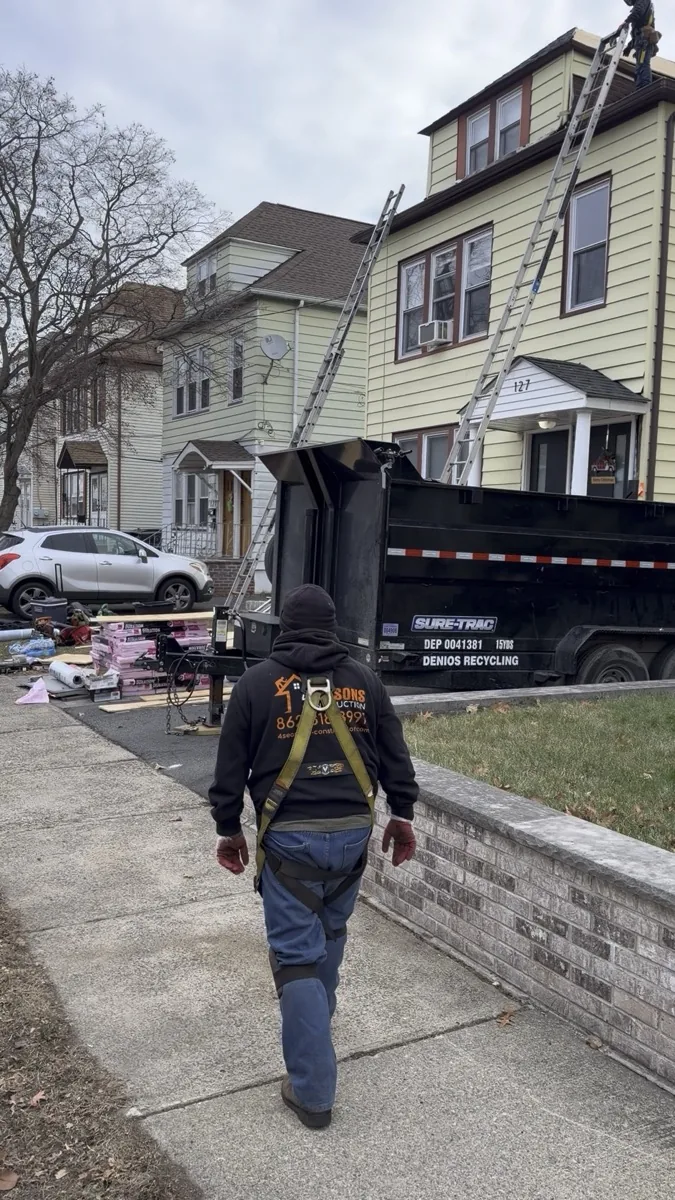
The crew gets there, traces the entry point, and stabilizes it before they leave. Torn or lifted shingles get a tarp battened down and lapped against the wind so it holds through the rest of the storm. A failed chimney or sidewall flashing gets temporary counter-sealing that buys time until a real rebuild. A flat-roof seam gets a patch under the cover. A puncture gets rigid sheathing over the hole. You get photos of all of it, plus a plain written note on what the permanent fix should be. After that the work moves at normal speed, either through our Little Falls roof repair service for contained damage, or into a Little Falls Storm Damage Roof Repair claim when a real weather event caused it. Nobody is going to stand on your lawn at midnight and sell you a whole new roof. That is not how we work.
Sideways Rain Is the Quiet One
The storms that fill our Little Falls board are usually not the loud ones. A nor'easter is a grinder, fifteen or twenty hours of rain coming in almost flat with the wind behind it, and it tests a roof in ways a quick summer thunderstorm never does. We get twenty-five to thirty thunderstorms a year here and they make noise, but the long easterly blows do the sneaky damage. Sideways rain gets driven up under the shingle courses at the eaves, in through gable vents, and into flashing laps that shrug off straight-down rain without a problem. That is why so many storm leaks turn up on roofs that look perfect from the sidewalk. The owner is baffled. The shingles are fine, but the ceiling is staining anyway, because the way in was a lap or a vent, not a hole. If your roof only leaks during long stretches of wind out of the east, say so when you call. That pattern is a clue, and it usually cuts the search down to one or two spots.
The Insurance Side, Done Honestly
Wind, falling limbs, and sudden storm damage are covered under most Little Falls homeowner policies, and your policy actually requires you to limit further damage once it starts. A same-night tarp is exactly that, with a receipt to prove it. Flood is its own thing here, separate from your roof policy, which is one more reason to know which kind of water you are dealing with. Our documentation habit, dated photos of the cause, the inside damage, and the temporary cover, exists because adjusters move faster when the story is told in pictures. We will meet the adjuster on the roof and point at the same flashing they are looking at. And when a claim is not worth filing, we say so, because a repair that barely clears your deductible can cost you more at renewal than it gives back. You get the math, then you call it. Seniors and military get a discount, and there is financing on larger jobs.
After the Tarp, Here Is the Fix
The cover buys you time. The repair is the real answer. Roof repair in Little Falls handles the permanent patch once the storm clears, Little Falls Roof Leak Repair is for water that keeps finding a new way in, and Little Falls, NJ Flat Roof Repair is for the low-slope sections on the bigger buildings. When the roof is simply done, roof replacement in Little Falls lays out the math. How our 24/7 line works is spelled out on the main emergency roof repair page, the roof repair service overview walks the whole process, and every town we cover is listed in one place.
Who Covers What on a Little Falls Job
| Part of the job | Backed by | For how long |
|---|---|---|
| Workmanship on the install | Four Seasons, in writing | 2-year warranty |
| Roofing materials | The manufacturer (GAF or Owens Corning) | Up to 50 years |
| Inspection and photo report | Four Seasons | Free, before any quote, no obligation |
| The estimate | Four Seasons | Written and itemized before work starts |
| Permit and inspection | Little Falls building department | We file it and schedule around the inspection |
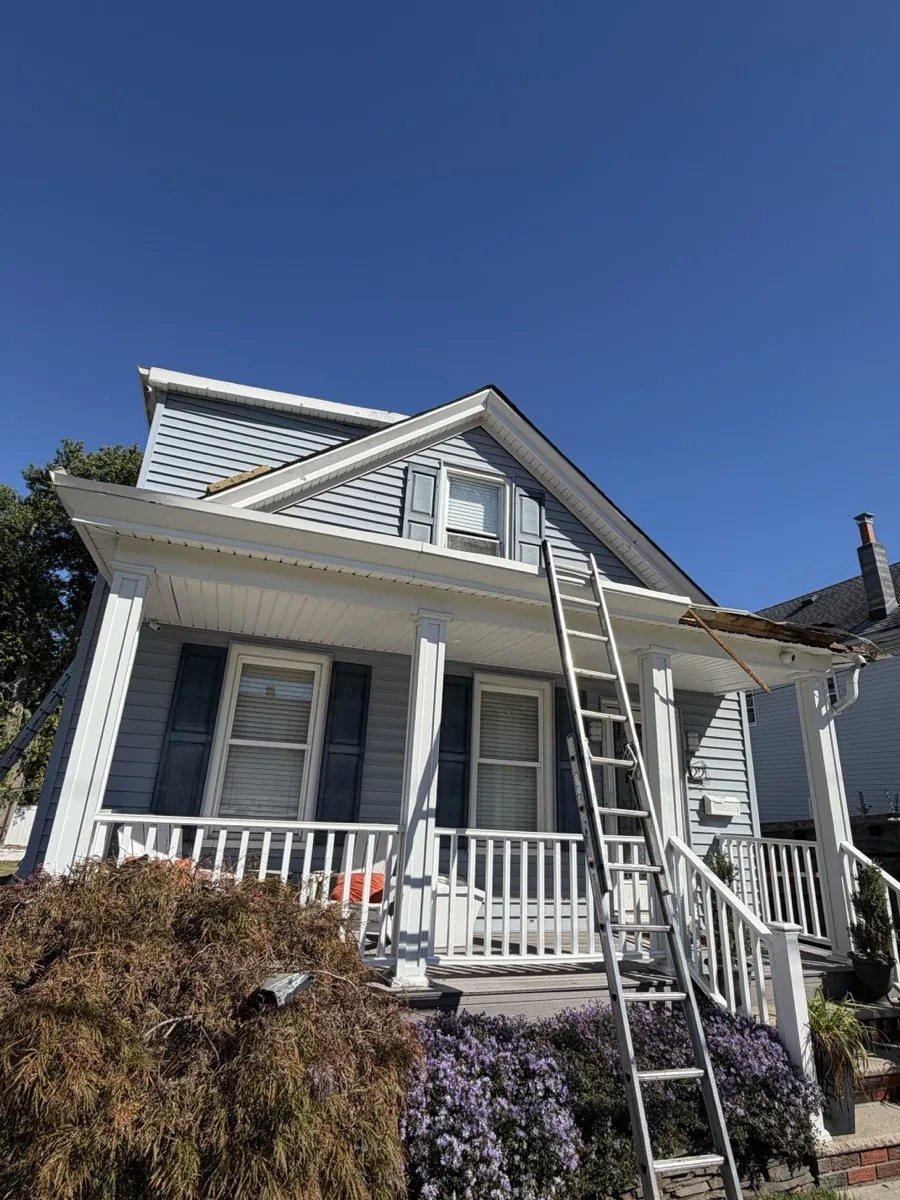
From Clifton to Your Block in Minutes
Four Seasons Roofing and Construction works out of 38 Speer Ave in Clifton, right next door, a short run into Little Falls whether you are in Singac, the Center of Town, or up by Great Notch. US 46 and Route 23 cross the town and the Parkway and I-80 sit close by, so the truck gets there fast. We carry roofing, siding, chimney, and masonry trades in-house and we serve Clifton, Totowa, Wayne, Woodland Park, Cedar Grove, and the rest of the neighbors every day. The full statewide rundown lives on our emergency roof repair page.
Call (862) 318-3997 Get a Free Roof Estimate →
Nearby and need a crew tonight? We also cover emergency roof repair in Woodland Park and Clifton. When the ceiling starts dripping, the number is (862) 318-3997.
How a Job Actually Runs
You reach out
Call (862) 318-3997 or send the form. We do not need the whole story up front, just the address and what you are seeing.
Free inspection
We come out and look at the roof. The inspection is free and there is no obligation either way.
We photograph what we find
A photo of a cracked boot or a rusted valley settles the question faster than a paragraph, so you see the roof rather than hear about it.
Written itemized estimate
The material tier and the decking allowance are broken out as their own numbers, so you can change any of them before you sign.
The work
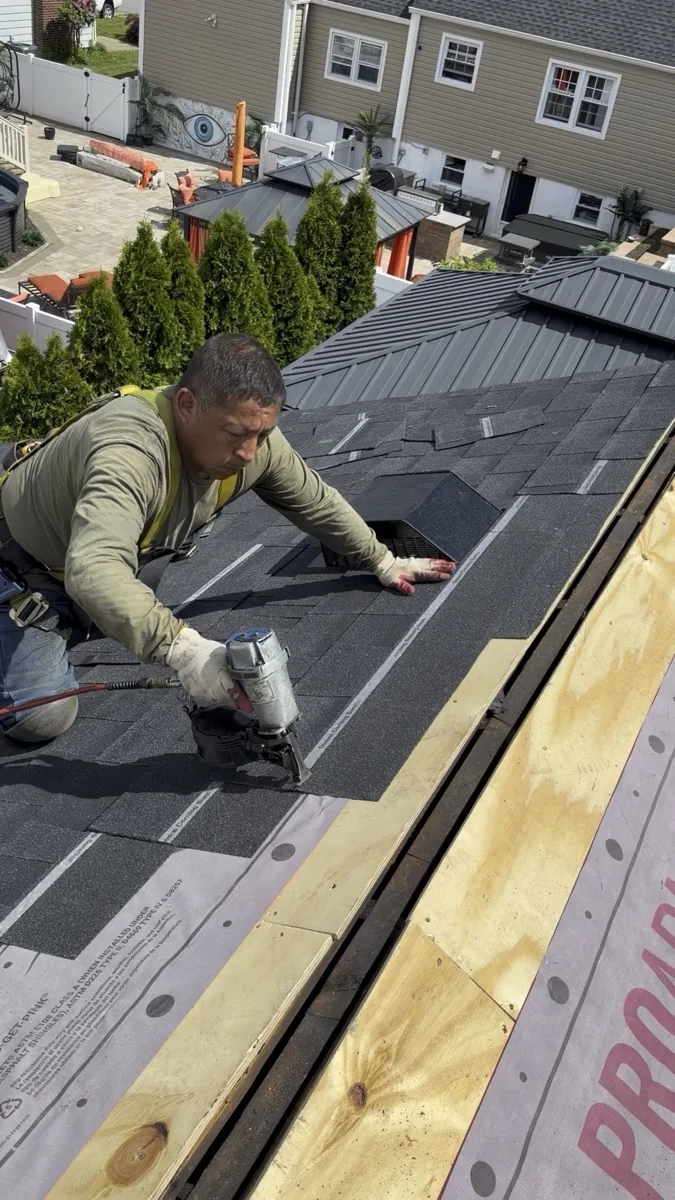
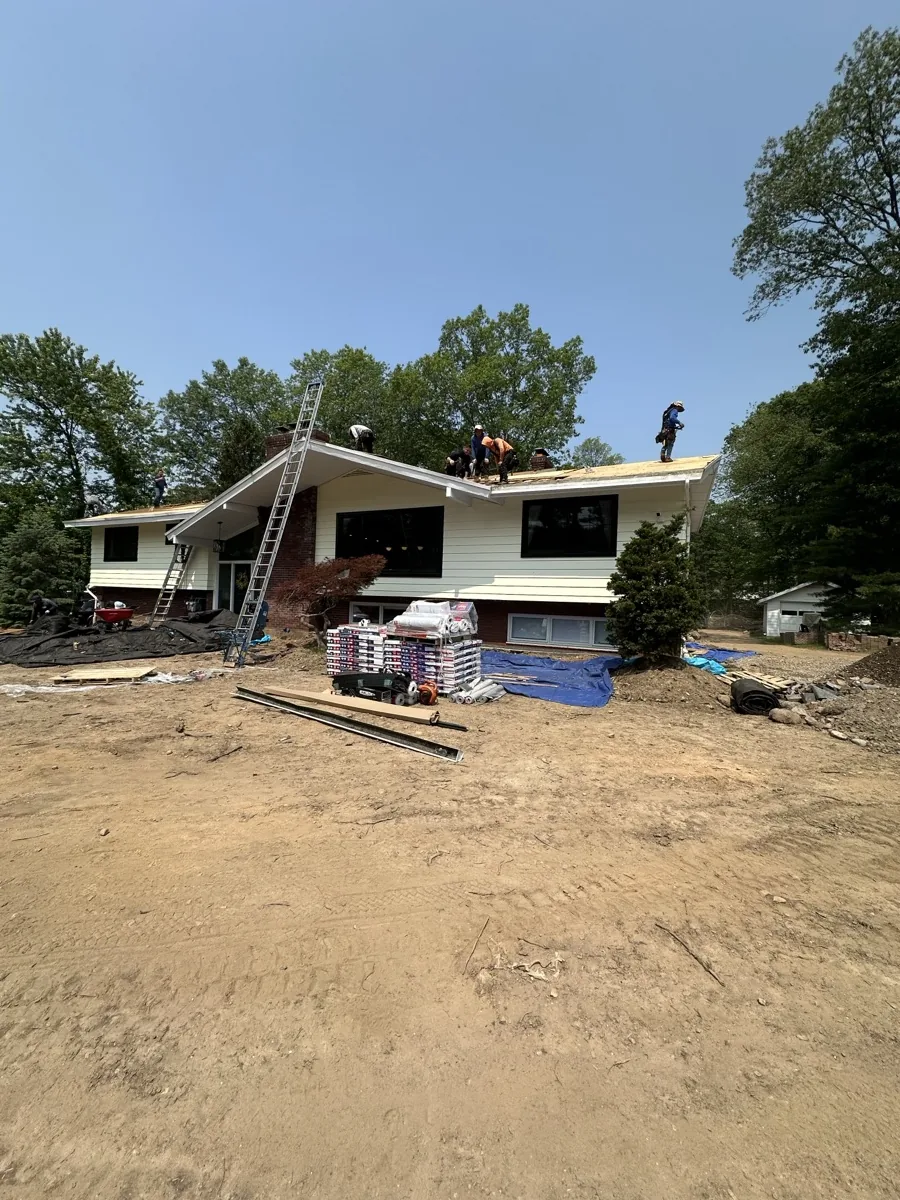
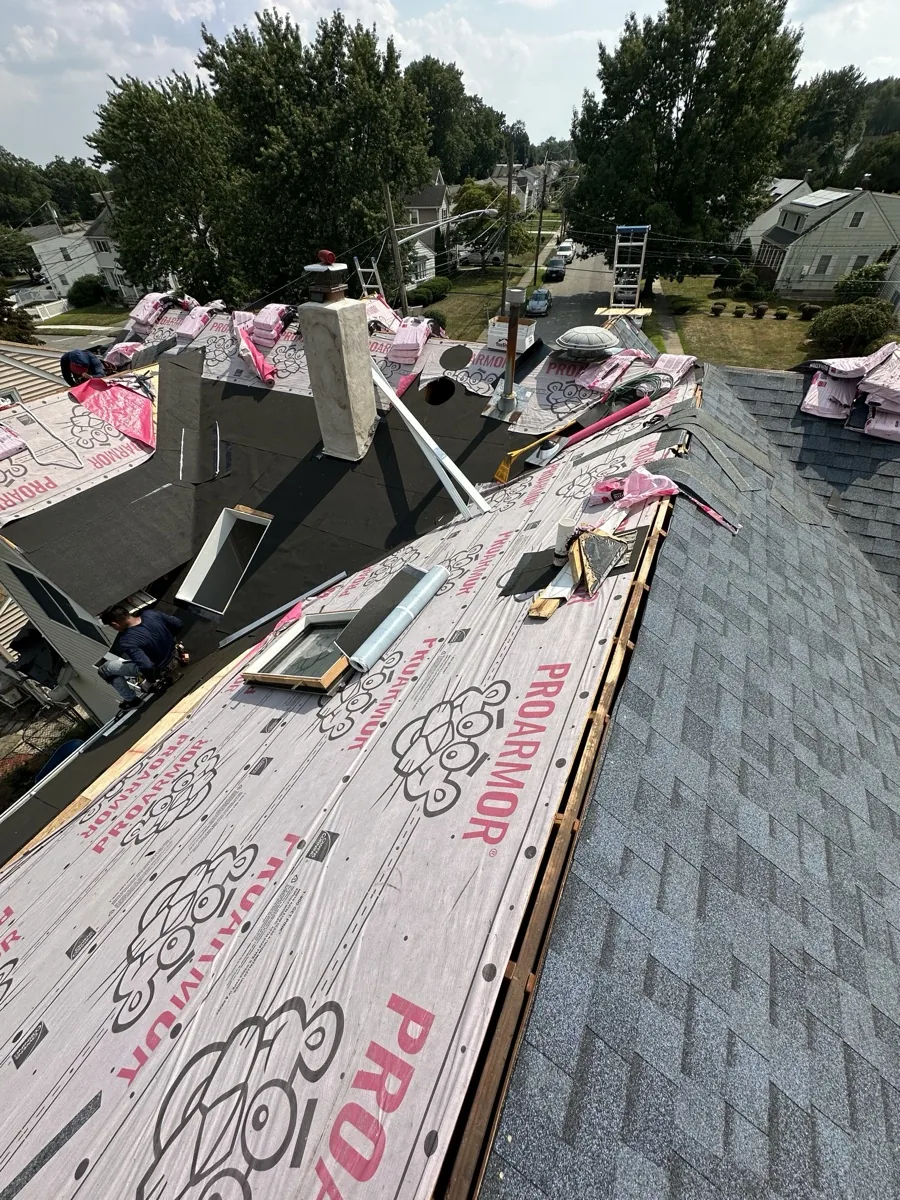
We tear off rather than lay over on almost every house, because a layover means nobody ever looks at the deck. Bad boards get replaced as we find them and photographed one at a time.
After the job
Decking is billed against the allowance written into the contract before anyone climbed a ladder, and the work carries a 2-year workmanship warranty with a 50-year manufacturer warranty on the material.
Little Falls Emergency Roof Questions
In Little Falls, water is dripping through a ceiling light. Is that dangerous?
Yes. Shut off the breaker for that room before you touch anything, leave the fixture off, and tell us water has reached wiring when you call so the crew knows what they are walking into.
My building's flat roof is ponding after the storm. Emergency or not?
If water is inside or a ceiling is sagging, yes, tonight. If it is just standing up there and the inside is dry, send a photo and we will tell you whether it is a today problem or a this-week drainage fix.
How late can I call you in Little Falls?
Whenever the water shows up. The leak does not check the clock and neither does the line. We answer through the night.
Can you match my shingles on the permanent repair?
Almost always close enough that nobody on the street notices. The night visit just stops the bleeding. Matching happens later, at the repair stage, with samples you sign off on.
Do you come to Singac and Great Notch, or just the center?
All of it. Singac on the west, Great Notch on the east, the Center of Town, the blocks up around Montclair State. We are next door in Clifton, so it is a short run to any of it.
Emergency Roof Repair in Towns Next to Little Falls
We work the same streets on both sides of the Little Falls line. Little Falls bordered by Clifton, Totowa, Wayne, Woodland Park (Passaic Co.).
Driving Directions to Four Seasons From Around Little Falls
Every Little Falls job runs out of our shop at 38 Speer Ave in Clifton. Pick the bordering town you are driving from and the map opens turn-by-turn directions to the door.
From Woodland Park, NJ
From Cedar Grove, NJ
From Montclair, NJ
Get a free roof estimate
We inspect first and photograph what we find, then put an itemized number in front of you. No obligation either way.
- Free inspection before any quote
- Written estimate, itemized line by line
- 2-year workmanship warranty
Rather talk it through? (862) 318-3997